Convert Image AI: How to Convert Images to Adobe Illustrator Files
QRImager - Images come in many different formats, and each one serves a different purpose. JPG is commonly used for photographs, PNG is popular for graphics with transparent backgrounds, and SVG is widely used for scalable vector artwork. But what if you need an image in Adobe Illustrator's AI format?
The Convert Image AI process allows you to prepare existing images for use in Adobe Illustrator. Whether you are working with a logo, an illustration, or a product image, converting your file can help you incorporate it into a design project.
However, converting an image to AI is not always the same as turning it into a vector. Understanding the difference can help you choose the right tool and get the results you expect.
In this guide, we will explain how image-to-AI conversion works, explore different conversion methods, and share practical tips for preparing your images.
What Does Convert Image AI Mean?
The phrase Convert Image AI usually refers to converting an image into an Adobe Illustrator Artwork file, which uses the .ai file extension.
Adobe Illustrator is a graphic design application used to create logos, illustrations, icons, typography, and other visual materials. Its AI format can store vector artwork, text, shapes, and raster images within a design document.
For example, if you have a JPG logo that you want to use in an Illustrator project, you can place the image into an Illustrator document and save the document as an AI file.
If you want to edit the individual shapes of the logo, however, you may need to trace or recreate the image as vector artwork.
This distinction is important because simply changing an image's file format does not automatically make its contents editable.
What Is an AI Image File?
An AI file is a document format associated with Adobe Illustrator. It is commonly used in graphic design workflows where artwork needs to be created, adjusted, or prepared for different purposes.
AI documents can contain several types of content, including:
-
Vector paths: Lines, curves, and shapes that can be resized without losing their original sharpness.
-
Text elements: Text objects that can remain editable when the document preserves them as text.
-
Raster images: Photographs and other pixel-based graphics placed inside the document.
-
Colors and effects: Design properties used to create the intended appearance of artwork.
-
Multiple design elements: Different objects arranged together within a single project.
An AI file can be useful when you need to continue editing a design in Illustrator. However, its editability depends on the contents of the document.
A JPG image embedded in an AI file remains a raster image, even though the overall document uses the AI format.
Why Convert an Image to AI Format?
There are several reasons to convert an image to AI format, especially if you work with graphic design, branding, or digital illustrations.
1. Make Images Ready for Design Projects
An image converter can help prepare graphics for use in an Illustrator project.
For example, you might have a product photo, a logo, or a promotional graphic that needs to be combined with text, shapes, and other design elements.
By placing the image inside an AI document, you can organize it alongside the other elements of your project.
2. Create Editable Vector Graphics
If you need to modify individual parts of an image, vector artwork may be more suitable than a flat raster image.
Converting a simple logo into vector paths can make it easier to change its colors, adjust its proportions, or edit individual shapes.
This process usually involves image tracing or manually recreating the artwork. The quality of the result depends on the source image and the complexity of the design.
3. Prepare Logos for Different Sizes
Logos are often used in different places, from small business cards to large banners.
Vector artwork can be resized while maintaining sharp edges, making it useful for branding projects.
If your original logo is a JPG or PNG, converting it into an AI document alone will not provide this benefit. You need to create or obtain a vector version of the logo.
4. Support Professional Design Workflows
AI files are commonly used in illustration, advertising, packaging, and print design.
Keeping artwork in an Illustrator-compatible document can make it easier to continue editing a project and prepare it for different applications.
Depending on the project, you may eventually need to export the finished design as PDF, SVG, PNG, or another format.
How to Convert an Image to AI Format
There are several ways to convert an image to AI format. The best method depends on whether you want to preserve the original image or turn it into editable vector artwork.
Method 1: Convert an Image Using Adobe Illustrator
Adobe Illustrator allows you to place images into a document, trace raster graphics, and save your work in AI format.
Follow these steps:
-
Open Adobe Illustrator on your computer.
-
Create a new document or open an existing project.
-
Select the Place option to import your JPG, PNG, or other supported image.
-
Adjust the image's size and position.
-
If you need vector artwork, select the image and open the Image Trace options.
-
Choose a tracing preset or adjust the settings to suit your image.
-
Review the tracing result and refine it if necessary.
-
Expand the tracing result when you want to work with the generated vector paths.
-
Save your document using the AI format.
The exact steps and interface may vary depending on your Illustrator version.
For photographs, tracing can generate a large number of paths and may not produce a practical editable illustration. For simple logos and icons, the results can be easier to manage.
Method 2: Use an Online Image Converter
An online image converter can be a convenient option if you want to process an image without installing desktop software.
Some tools support direct AI conversion, while others offer formats such as SVG or EPS that can be used in an Illustrator workflow.
Here is the general process:
-
Open an online converter that supports your intended output format.
-
Upload the image from your device.
-
Select AI as the output format, if available.
-
Adjust any conversion settings.
-
Start the conversion process.
-
Download the resulting file.
-
Open the file in compatible software and inspect the result.
Before using a converter, check that it actually produces a valid AI file. A tool that converts JPG to SVG, for example, does not necessarily create an AI document.
If AI is not available as a direct output option, you may be able to convert the image to SVG first and then open the SVG in Illustrator.
Method 3: Convert an Image to SVG Before Saving as AI
SVG is a vector graphics format supported by many design applications, including Adobe Illustrator.
If your converter does not support AI output, SVG may provide a useful intermediate format.
Follow these steps:
-
Upload your image to a suitable image-to-vector converter.
-
Select SVG as the output format.
-
Download the converted SVG file.
-
Open the file in Adobe Illustrator.
-
Inspect the vector paths and overall appearance.
-
Edit the artwork if necessary.
-
Save the document as an AI file.
This method can work well for simple illustrations, icons, and logos.
However, not every SVG conversion produces clean vector artwork. Some tools may embed the original raster image inside the SVG rather than tracing it into paths. Check the result before relying on it for a project that requires editable vectors.
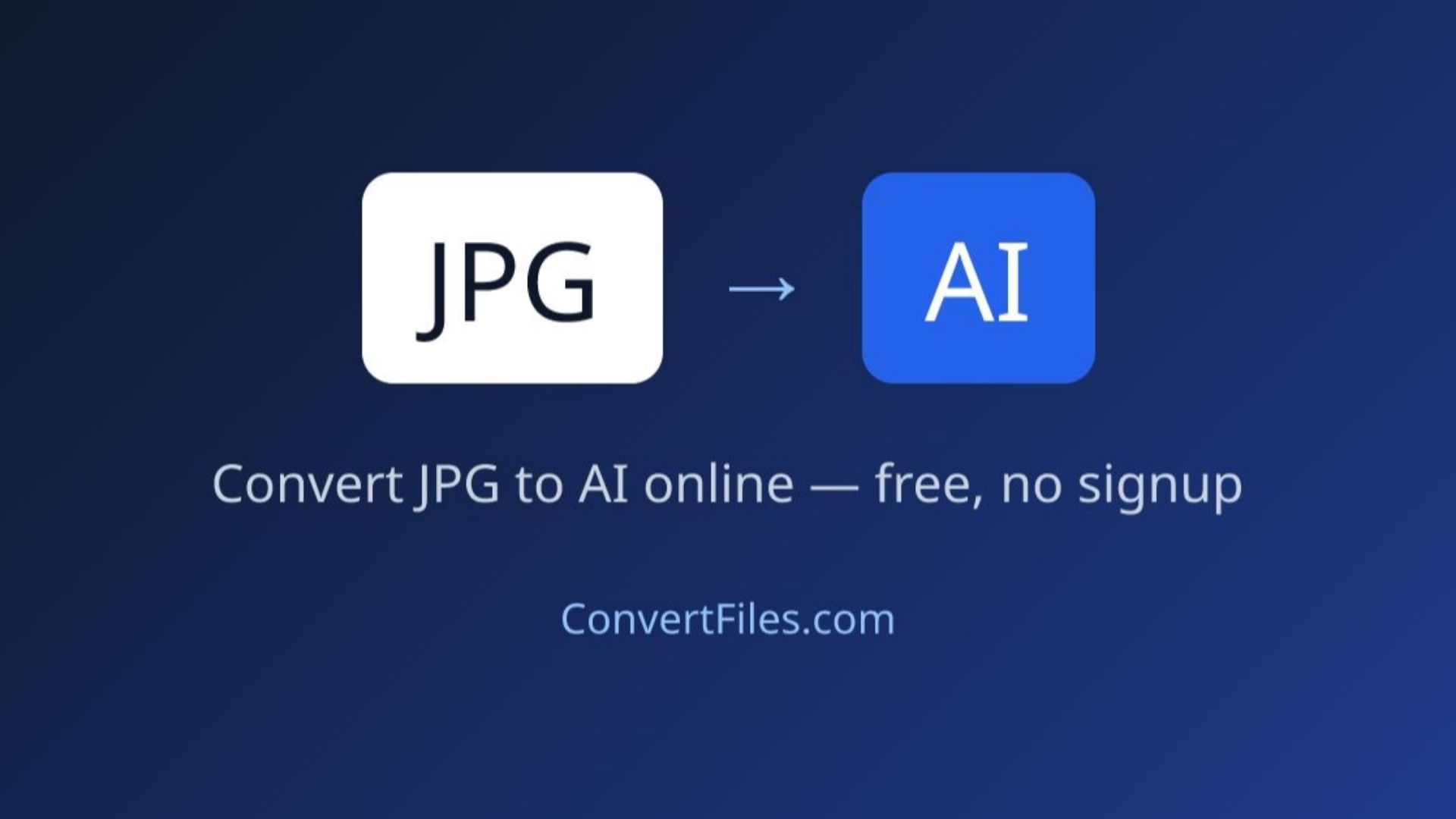
Convert JPG to AI
JPG is one of the most common image formats for photographs and everyday graphics.
You can place a JPG image into an Illustrator document and save the document as AI. This is useful when you want to combine a photograph with other design elements.
If you want to convert JPG into editable vector artwork, you will need to trace or recreate the image.
For example, a simple black-and-white logo may be relatively straightforward to trace. A detailed photograph with many colors, textures, and shadows can be much more challenging.
For many photographic projects, keeping the JPG embedded in the AI document is a practical option.
Convert PNG to AI
PNG is commonly used for logos, illustrations, screenshots, and graphics that require transparent backgrounds.
You can import a PNG into Illustrator and save the project as an AI document. This allows you to use the image alongside other elements in your design.
If transparency is important, check that the background remains transparent after importing or converting the image.
For editable vector artwork, you can use image tracing or recreate the design with vector shapes.
A clean PNG with clear edges and a simple color palette may be easier to trace than a complex image with many fine details.
Convert WebP to AI
WebP is an image format often used for website graphics and photographs. It supports both lossy and lossless compression, as well as transparency.
If you have a WebP image that you want to use in an Illustrator project, check whether your version of Illustrator supports the file directly.
If it does not, you can convert the WebP image to a supported format, such as PNG, before importing it.
Once the image is available in Illustrator, you can place it in a document and save the project as AI.
Remember that converting WebP to AI does not automatically create vector paths. The image remains pixel-based unless you trace or recreate it.
AI vs. SVG vs. EPS: Understanding the Differences
AI, SVG, and EPS are all associated with graphic design, but they serve different purposes.
|
Feature
|
AI
|
SVG
|
EPS
|
| --- | --- | --- | --- |
|
Primary use
|
Illustrator design documents
|
Scalable vector graphics
|
Graphics exchange and print workflows
|
|
Vector artwork
|
Supported
|
Supported
|
Supported
|
|
Raster images
|
Can be included
|
Can be embedded or linked
|
Can be included
|
|
Common applications
|
Adobe Illustrator
|
Browsers and design software
|
Design and publishing software
|
|
Typical extension
|
.ai
|
.svg
|
.eps
|
AI is useful for projects that will continue to be edited in Illustrator. SVG is widely used for web graphics, while EPS can be useful in certain print and publishing workflows.
The most suitable format depends on the software you use and the requirements of your project.
Tips for Better Image Conversion Results
A few simple practices can help you achieve better results when converting images to AI.
Start With a High-Quality Image
Use the highest-quality source image available. Low-resolution files may contain blurry edges or compression artifacts that make tracing more difficult.
For logos and illustrations, a clean source image can help produce more accurate results.
Choose the Right Conversion Method
If you only need to place an image in an Illustrator project, importing it and saving the document as AI may be enough.
If you need scalable, editable artwork, consider image tracing or manually recreating the design.
Choosing the right method can help you avoid unnecessary steps.
Use Simple Images for Vectorization
Images with clear outlines, solid colors, and simple shapes are generally easier to trace than detailed photographs.
If you are converting a logo, try to use a version with a clean background and well-defined edges.
Check the Final File
After conversion, open the result in compatible software and inspect the artwork.
Look for missing elements, unexpected backgrounds, rough edges, and changes in color. If you need editable vectors, check whether the image consists of actual paths or remains an embedded raster image.
Keep the Original Image
Always retain a copy of the original file. This allows you to try another conversion method or adjust the settings without losing the source image.
It is particularly useful when working with important logos, business graphics, or client projects.
Common Problems When Converting Images to AI
Image conversion is usually straightforward, but a few issues can affect the final result.
The image is not editable. The original image may simply be embedded in the AI document. Use tracing or recreate the artwork if you need editable vector paths.
The converted artwork looks blurry. Saving a low-resolution image as AI does not increase its original detail. Use a higher-quality source or create vector artwork.
The file will not open. The converter may have produced a different format or an incompatible file. Confirm the output format and try opening it in compatible software.
The background has changed. Some conversion workflows may not preserve transparency. Review the original file and the converter's settings.
The file size is too large. High-resolution embedded images and complex vector paths can increase file size. Consider optimizing the source image or simplifying unnecessary elements.
Understanding these issues can help you choose the right solution for your project.
Is It Safe to Use an Online Image Converter?
Online converters can save time, but it is important to consider how your files are handled.
If your image contains private information, confidential business material, or client artwork, review the service's privacy policy before uploading it.
Here are a few useful precautions:
-
Check whether uploaded files are stored and how long they are retained.
-
Use websites that provide a secure HTTPS connection.
-
Avoid uploading sensitive images to unfamiliar services.
-
Review the converted file before using it.
-
Consider software that processes images locally when privacy is a priority.
Not all online converters work the same way. Some upload images to a server, while others may process files directly in your browser.
Frequently Asked Questions
1. What does Convert Image AI mean?
Convert Image AI generally refers to converting an image into Adobe Illustrator's AI document format. Depending on the method, the result may contain an embedded raster image or editable vector artwork.
2. Can I convert an image to AI for free?
Some online converters and design applications offer free conversion options. However, direct AI export, file size limits, and advanced features vary between services.
Check the available output formats before uploading your image.
3. Can I convert JPG to AI without losing quality?
Placing a JPG inside an AI document does not restore details lost through JPG compression. If you trace the image into vectors, the result may scale without pixelation, but the visual accuracy depends on the tracing process.
4. Is an AI file always a vector?
No. An AI document can contain vector artwork, raster images, or a combination of both. The file extension alone does not guarantee that the image is made of editable vector paths.
5. Can I convert PNG to AI online?
Yes, provided the online converter supports PNG input and AI output. If direct AI conversion is unavailable, you may be able to convert the image to SVG and open it in Illustrator before saving it as AI.
6. What is the difference between AI and JPG?
JPG is a raster image format commonly used for photographs. AI is an Illustrator document format that can contain editable vector artwork, text, and raster images.
JPG is convenient for sharing images, while AI is commonly used for design projects.
7. Can I convert a photo into a vector AI file?
Yes, but the process involves vectorization rather than simply changing the file format. Tracing a photograph can produce complex artwork, so the result may require manual adjustments.
For many photographs, keeping the original raster image inside an AI document is more practical.
Conclusion
The Convert Image AI process is useful when you need to prepare images for Adobe Illustrator and other design workflows.
Whether you are working with JPG, PNG, or WebP, you can place supported images into an Illustrator document and save the project in AI format. If you need editable vector artwork, you may need to use image tracing or recreate the design.
The most important thing is to choose the right method for your needs. Consider the original image quality, the level of editability you require, and the format supported by your design software.
With the right approach, converting images to AI can become a simple part of your graphic design workflow.
